Rethinking work. Not just the workforce.
How UK business leaders are bringing together recruitment, skills, AI and leadership to prepare for what’s next.

Workforce strategy now reaches far beyond forecasting demand and recruiting the right people. Decisions about talent are inseparable from decisions about technology, skills, growth and business risk.
For UK leaders, the task spans who performs the work, how roles are designed, which capabilities need to be built and how people are supported as conditions continue to shift.
Drawing on The Adecco Group’s 2026 global study of 2,000 C-suite executives across 13 countries – including 150 in the UK – and first-hand perspectives from organisations navigating these changes in practice, five defining themes stand out. Together, they show how businesses are connecting talent, skills, technology, risk and leadership as part of business strategy.
Business leaders are facing disruption from several directions at once. Technology, geopolitics, regulation, government policy and sector transformation are converging, making workforce decisions increasingly difficult to separate from wider business risk.
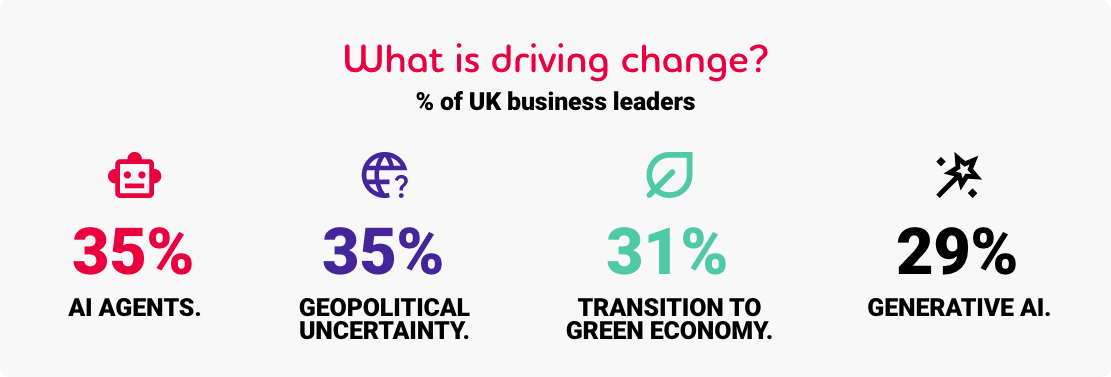
UK findings from The Adecco Group’s Business Leaders Survey reflect this broader planning environment. Around a third cite AI agents (35%) and geopolitical uncertainty (35%) as the megatrends likely to have the greatest impact on their organisation over the next five years, while almost a third point to the transition to a green economy (31%) and generative AI (29%).
For leaders, attention is turning to what these shifts mean in practice. As one Director of Flexible Talent in financial services put it: “We’re pretty sure we need to change. But what we don’t have is a clear picture of what and how.” Reflecting on AI specifically, he described how early excitement can give way to a more proportionate and pragmatic understanding, adding: “We’re not through that curve yet.”

The tensions vary sharply by sector. Chris Holloway, Head of Labour Relations at Bentley, described the challenge as “launching our future electric programme, preparing our people for the new technology, but remaining resilient in an increasingly uncertain world.” One food-production business pointed to grain supply, geopolitical conflict and rising raw-material costs, alongside employment legislation and continued automation.
In utilities, climate change is increasingly shaping operational planning. As one Chief People Officer warned: “If climate change keeps moving and keeps growing, that is going to put more and more pressure on our network to be able to supply people with what they need.”
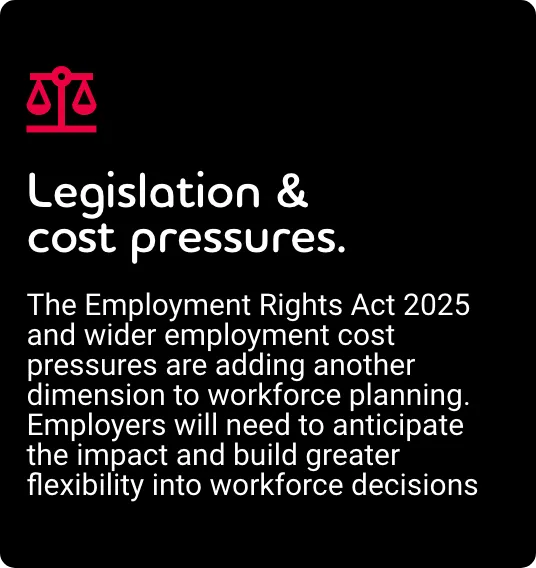
Government policy and employment legislation are also shaping workforce decisions. With the Employment Rights Act 2025 being implemented in phases across 2026 and 2027, employers are having to anticipate legislative developments alongside wider employment costs. One senior leader we spoke with said changes to employment legislation and National Insurance had already required shifts in recruitment and growth strategy.
The effects reach into wider business planning. As one Chief People Officer explained: “Whatever happens from a legal regulatory perspective from the government has an impact on how fast we go, how much we charge our customers, and also the ability to put money back in.”
For workforce leaders, resilience increasingly depends on understanding exposure and retaining enough flexibility to respond.
Hiring remains one of the most important decisions an organisation makes. But it is increasingly part of a much bigger question about how businesses secure the talent they need. Today’s workforce challenges require a broader approach to finding, engaging and mobilising talent.
The actions organisations are taking reflect that thinking. More than half of UK business leaders (51%) are creating apprenticeship or internship roles, while almost as many (48%) are encouraging greater internal mobility.
The search for talent is widening too. Some 45% are intentionally recruiting from non-traditional talent pools, while 43% are looking internationally for talent.
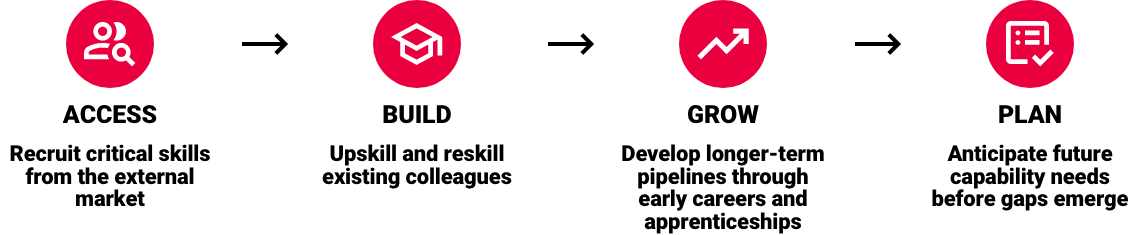
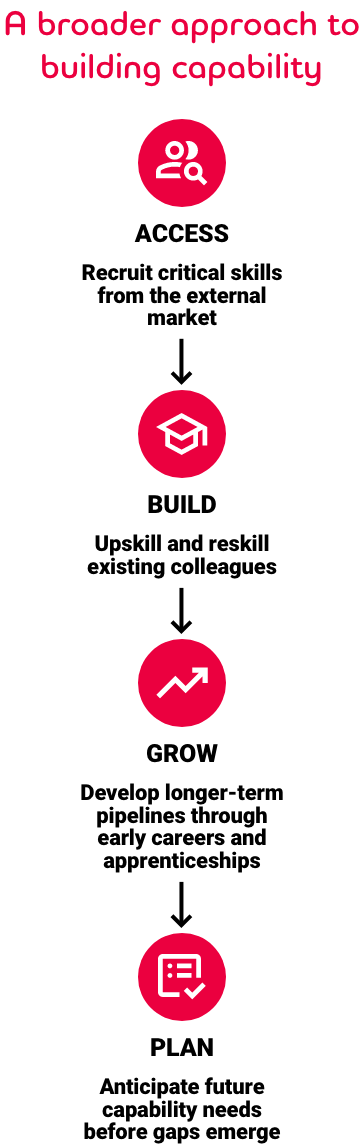
A broader approach to building capability
Flexibility is also shaping how organisations access talent. Almost six in ten (59%) are increasing their use of contingent or flexible talent, creating more options to respond as workforce needs shift.
Better workforce intelligence is supporting those choices. More than half (57%) are implementing technical solutions and improving data insights, including workforce planning, giving leaders greater visibility of where talent is available, where gaps are emerging and where different approaches may be needed.
For some organisations, access remains the immediate challenge. One leader we spoke with said: “One of the big things that will really shape our ability to deliver our plans is talent access, and whether we’re going to be able to access the right level of talent in the right way.” He pointed to early careers and apprenticeships as one response, while acknowledging: “There is definitely a gap that we will need to invest in. The lever we’re pulling is early careers and apprentices, but that pipeline takes a while to grow.”
For many leaders, this is changing how they secure the skills they need. At Bentley, this is prompting greater consideration of how future skills are developed: “We seem to be spending much more time thinking about the skills that we need for the future, how we help people adapt rather than expect that we’ll buy the skills in.”
For employers, securing future talent increasingly means widening the routes through which people enter, move through and contribute to the organisation.

Recruitment can bring new skills into an organisation, but in a fast-moving labour market, those skills have a shorter shelf life. Almost half of business leaders say AI has already changed the skills required for some roles (47%), putting greater emphasis on people’s ability to keep learning as their work develops.
As one leader put it: “Technical skills will always be important, but I think adaptability is probably the biggest skill organisations will need to succeed in the future.”
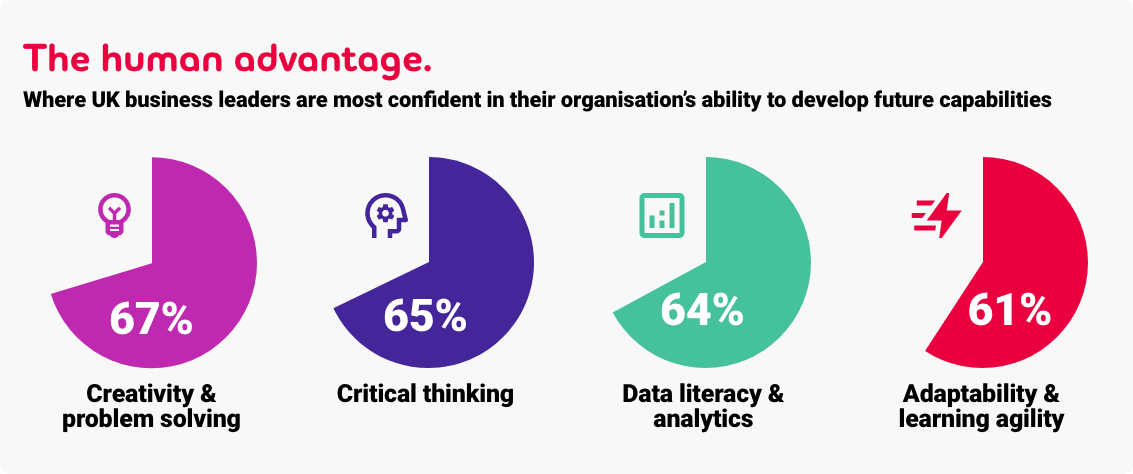
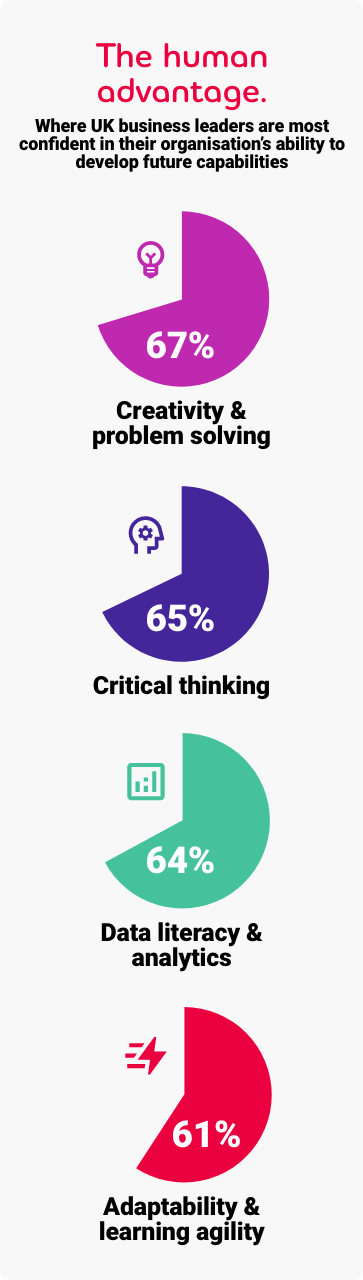
Leaders report confidence in developing creativity and problem-solving (67%), critical thinking (65%), data literacy and analytics (64%) and adaptability and learning agility (61%). The findings underline the importance of distinctly human strengths alongside the digital skills needed to work effectively with technology.
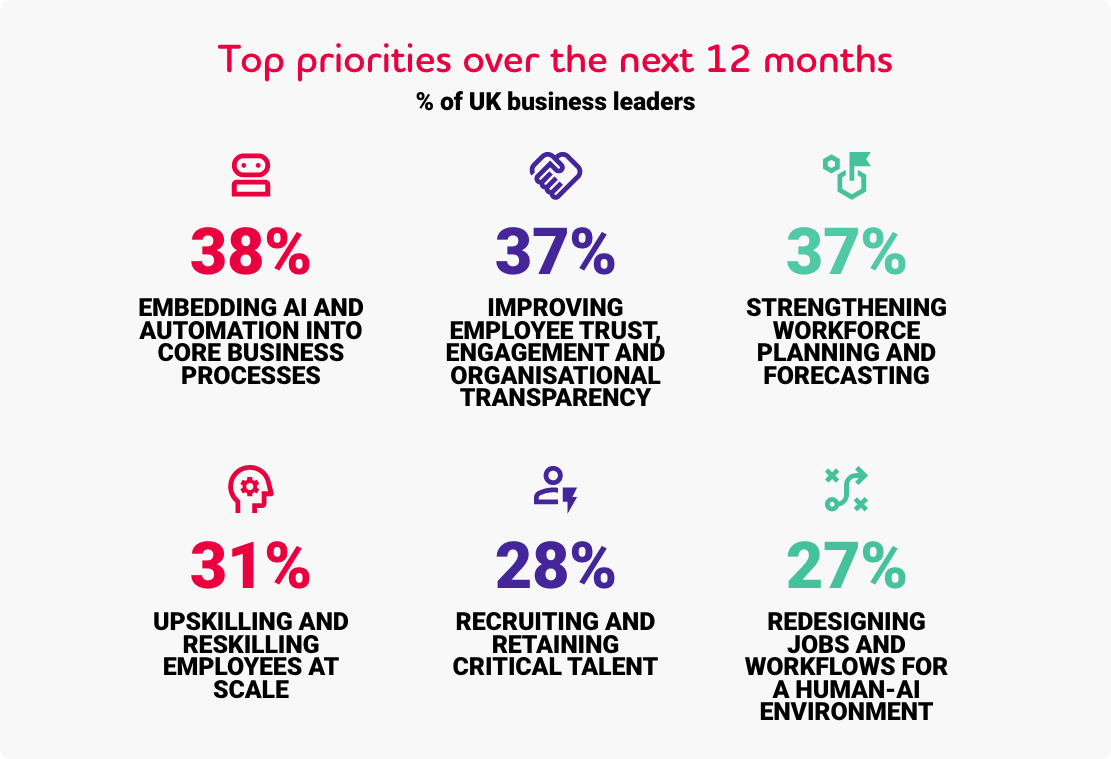
The question is whether the way organisations approach learning is keeping pace. Only 36% believe their current learning and development programmes are preparing employees for AI-enabled work.
Formal development is becoming more common, with 54% piloting or implementing upskilling opportunities, but continuous learning is further from being embedded into working life. Only 29% describe it as a core part of their culture and leadership model, and just 2% have fully integrated learning into performance frameworks and linked it to business outcomes.
The opportunity now is to move learning closer to the work itself. In financial services, a Head of Flexible Talent described an AI academy rolled out to nearly 60,000 colleagues, where the emphasis is as much on curiosity as technical knowledge: “Key to the success of this is for people to have the curiosity to use AI, leaning into it rather than moving away from it. That’s the culture we’re trying to create.”
AI literacy could also become a baseline expectation. Looking three to five years ahead, Alex Wolny, Commercial Director UK & EMEA at Gallagher, believes recruiting someone without “a solid foundation in how to deploy AI into their field” could become increasingly unlikely.
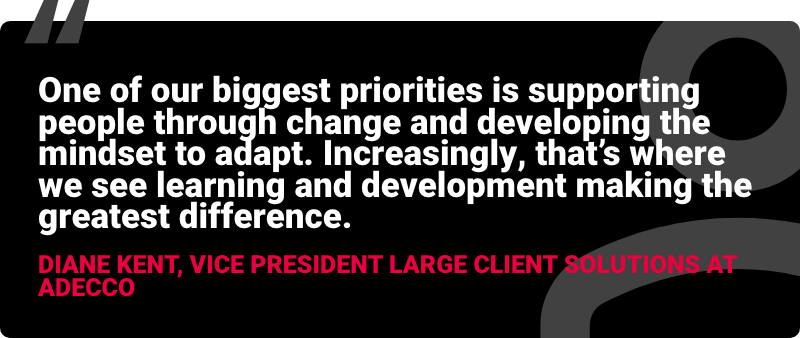
It is a direction Diane Kent, Vice President of Large Client Solutions at Adecco, also sees reflected in how organisations approach learning and development: “One of our biggest priorities is supporting people through change and developing the mindset to adapt. Increasingly, that’s where we see learning and development making the greatest difference.”
If the skills challenge is about preparing people to work with AI, the organisational challenge is creating the conditions for them to use it confidently, responsibly and at scale.
Confidence in the technology is running ahead of some of the structures needed to support it. While 61% of UK business leaders are confident in their organisation’s AI implementation strategy, the practical work of integrating AI into roles and workflows is less widespread. Just over half (53%) are involving employees and managers in designing new workflows, while 58% are using AI or analytics to determine which tasks are best suited to people and which to technology.
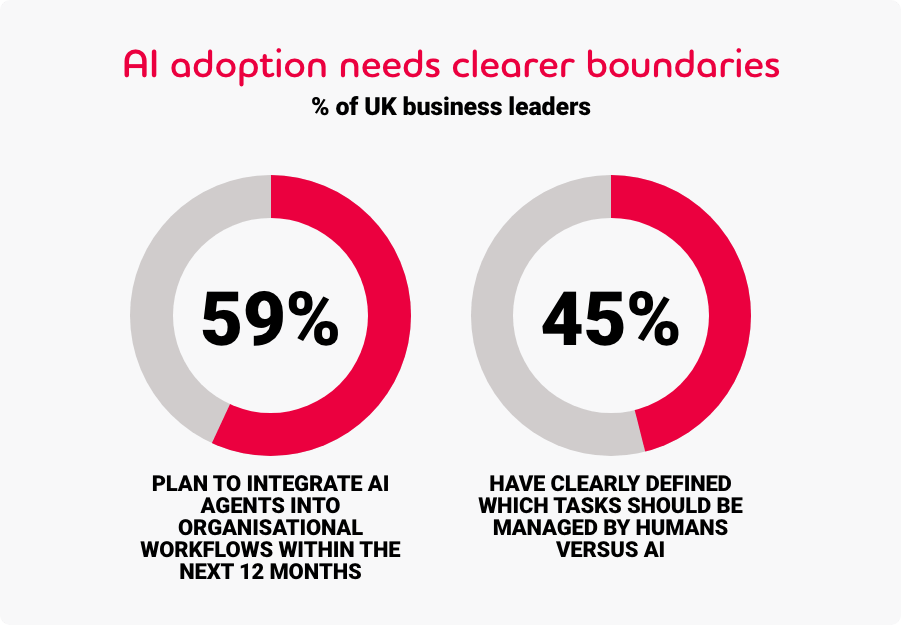
Closing that gap requires structure as well as ambition. Clear governance and guardrails give employees confidence about where and how AI can be used. Defined use cases and controlled pilots allow organisations to test what works, build evidence and share successful applications more widely. Involving employees in that process helps ensure AI reflects the realities of their work.
For one major global employer we spoke to, workforce data is another important part of that foundation. The organisation is looking beyond retrospective reporting towards predictive workforce analytics to support better resourcing and operational decisions.
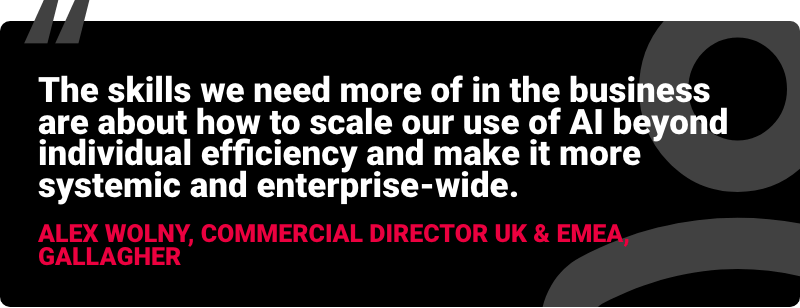
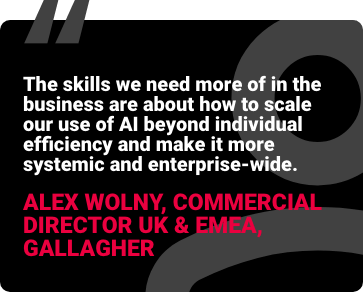
Stronger foundations become particularly important as organisations move from experimentation to scale. Wolny points to the capabilities needed to make that transition: “The skills we need more of in the business are about how to scale our use of AI beyond individual efficiency and make it more systemic and enterprise-wide.”
One leader we spoke to offered a glimpse of what AI adoption looks like inside a large, complex organisation. They explained that AI is already supporting document analysis and business communication and helping teams manage expanding responsibilities. Their experience also highlighted the importance of structured training, clear parameters for use and protecting critical thinking as adoption grows.
Greater use of AI is also sharpening the focus on where human contribution matters most. One financial-services executive expects employees to focus on “more sophisticated, client-facing activities that require more judgement, more human interaction and more oversight.”
Recruitment provides a practical example. As Kent explained: “Our clients want to be clear about how AI is used in recruitment. They value the efficiency it can bring, but they also want to keep the human touch. And so do we.”
Ultimately, the value organisations derive from AI will depend on how effectively people are equipped to use it.
The leadership brief is getting wider. Growth, technology, workforce transformation, trust and transparency increasingly must be managed together. Leadership models are starting to respond to these competing demands.
More than four in ten UK business leaders say employees are being directly involved in job redesign to make roles more flexible and future-ready (43%), while 41% say leadership KPIs now include people-focused outcomes such as trust, inclusion and wellbeing. Fewer report more decentralised and collaborative decision-making (39%) or redesigned leadership roles that balance human and AI decision-making (37%).
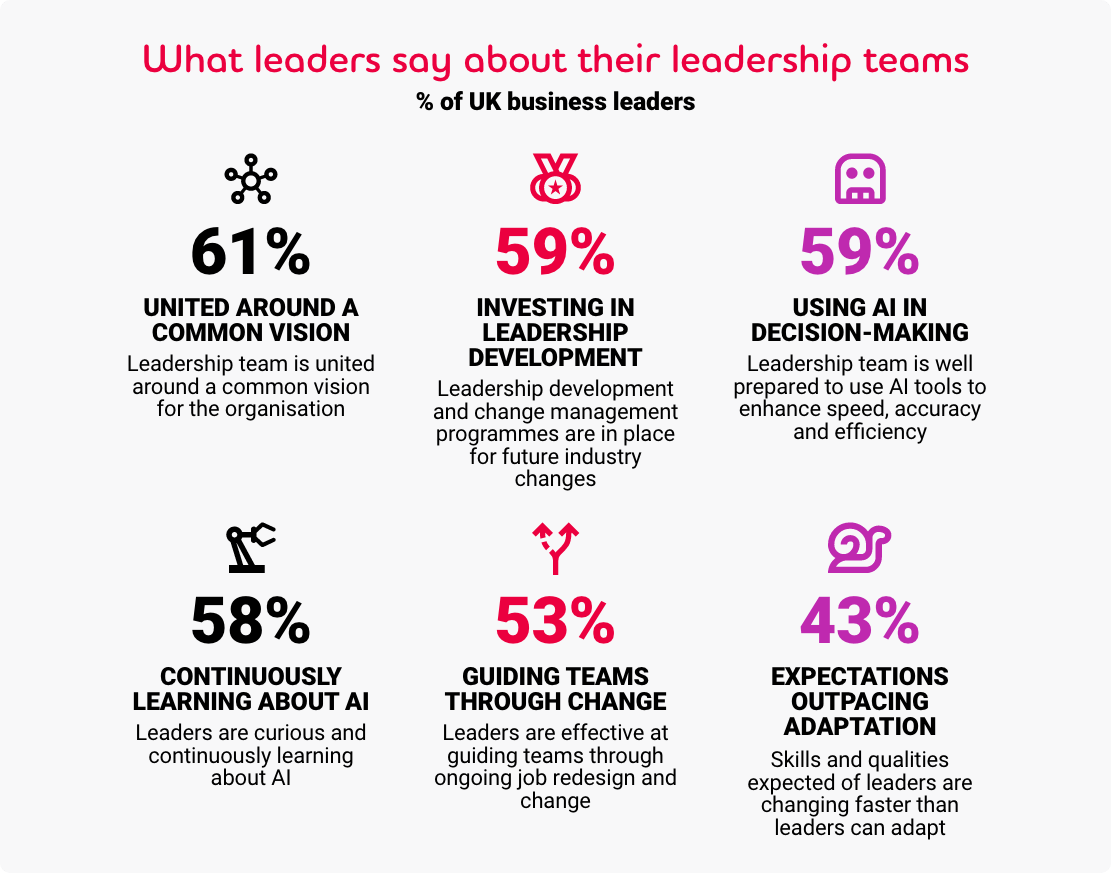
Expectations of leaders are shifting too. While 61% say their leadership team is united around a common vision for the organisation, 43% believe the skills and qualities expected of leaders are changing faster than they can adapt. Leaders are being asked to transform organisations while developing their own capabilities at the same time.
That shift is already influencing leadership strategy. In our conversation with a global services organisation, agility emerged as a defining capability for the years ahead, reflecting a view that change can no longer be managed as a temporary programme. Leaders increasingly need to combine that agility with accountability and a stronger focus on turning decisions into action.

As the role of leaders expands, trust remains central. For Holloway, that starts with the fundamentals: “I think people still want leaders who are honest, who are visible, and who listen.” During transformation, she added, people can cope with change “if they understand why it’s happening and they believe they’re being treated fairly.”
A Chief People Officer described the scale of the leadership challenge as “a step change in leadership”, arguing that senior leaders almost need “a software upgrade” for the phase organisations are moving into. As he put it: “Leaders have to manage the tension between running the operation and transforming the business.”
Across sectors, the same principles keep surfacing. Whether leaders are dealing with AI, electrification, regulation or supply-chain disruption, people need clarity, preparation and trust in the direction their organisation is taking.
Decisions about recruitment are increasingly connected to decisions about skills, technology, workforce design and leadership. The organisations best prepared for what comes next will be those that bring those decisions together, creating the talent, flexibility and confidence to respond as business needs change.
At Adecco, we help organisations turn that understanding into action. From talent intelligence and workforce planning to skills, recruitment and flexible workforce solutions, we bring together the expertise and market insight needed to make better workforce decisions.
Whatever that looks like for your organisation, the conversation starts with understanding what it means for your workforce.
EXPLORE HOW ADECCO CAN HELP YOU PREPARE FOR WHAT COMES NEXT
About the research.
This article draws on The Adecco Group’s 2026 Business Leaders research, a global study of 2,000 C-suite executives across 13 countries, collectively responsible for more than 8.6 million workers worldwide.
The UK sample comprises 150 C-suite executives spanning organisations of different sizes and a broad range of industries, from aerospace and defence, automotive and technology to healthcare, manufacturing and consumer markets. The research captures perspectives from across the executive team, including CEOs, CTOs, CHROs, CFOs and COOs.
More than two-thirds of UK respondents work for organisations employing over 1,000 people, including 44% in businesses with more than 5,000 employees, providing a senior leadership perspective on the forces shaping some of the UK’s largest employers.