The true ROI of your recruitment – numbers that actually matter (and how to measure them)

“What’s the ROI on our recruitment spend?”
If this question from your Finance Director makes you break into a cold sweat, you’re not alone.
Research shows that 85% of HR professionals agree recruitment is crucial to business success. But according to a 2024 CIPD report, only 24% of businesses measure the return on investment (ROI) of their recruitment processes.
Here’s why that needs to change – and how to measure ROI in the right way for your organisation.
The real recruitment numbers you need to track
At Adecco, we’ve helped numerous organisations track and understand their ROI data.
The key metrics successful businesses measure include:
1. Time-to-Revenue impact
Do you know the true cost of roles remaining unfilled?
For one client, we calculated the daily revenue per employee was £783.90. If a single role remained unfilled for six weeks, this would cost the business £23,517 in lost revenue.
Here’s the formula we use to calculate this across multiple vacancies:
[Monthly revenue per employee] × [Number of months position vacant] = True Cost of Vacancy
2. Quality of Hire impact
A strong hire in a senior role typically delivers 3-4 times greater value to a business that an average one.
We measure this by looking at:
- Revenue/profit per employee
- Project delivery speeds
- Team retention rates under their leadership
- Innovation metrics
3. Hidden Cost Savings
Analysing our client’s costs typically discovers a variety of hidden recruitment costs they weren’t tracking.
These can include:
To understand these costs in more detail, check out our blog on the true cost of recruitment and the real investment that goes into talent.
Real ROI in Action – A Case Study
Let’s look at how we achieved an improved ROI for one of our clients:
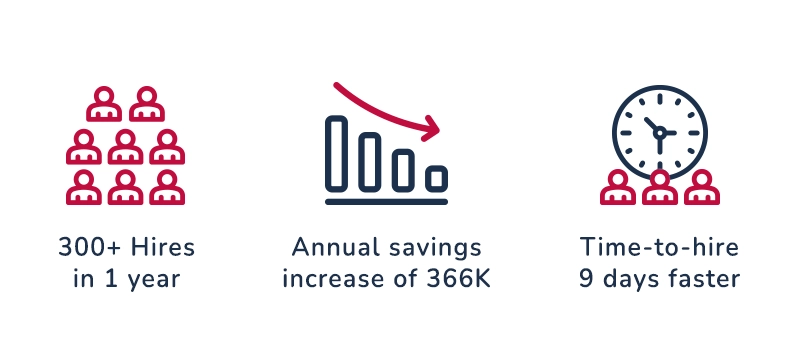
Adecco worked with a UK manufacturer to recruit for over 300 roles in a year. Compared to their previous approach to recruitment, we delivered an annual cost saving of £366,000. On top of this, we reduced we reduced the overall time-to-hire by an average of 9 days per role, which works out as over 2,700 days gained.
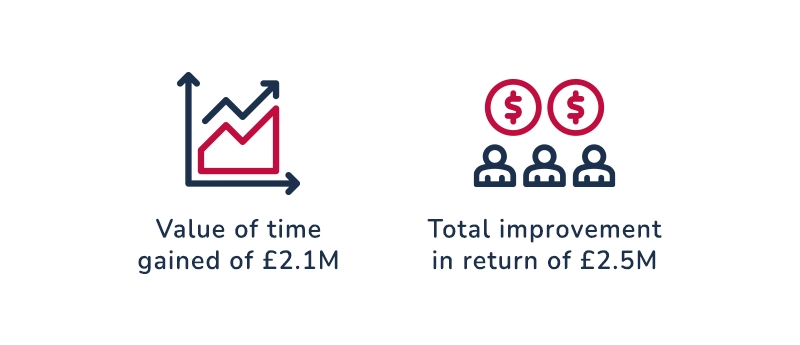
Based on the expected revenue per employee, we can estimate the value of this gained time to be £2.1M. Together, this means we delivered a total estimated improvement in return of £2.5M or £8,000 per employee.
How to calculate your true recruitment ROI
Here’s our proven three-step framework:
1. Establish Your Baseline
Calculate your current:
- Cost per hire (all-inclusive)
- Time to fill positions
- First-year retention rates
- Performance scores of recent hires
2. Measure Your Hidden Costs
Track these often-missed metrics:
- Internal time spent on recruitment
- Lost productivity from vacancies
- Training and onboarding costs
- Impact on team
3. Calculate Value Metrics
Closely monitor the:
- Revenue per employee
- Project completion rates
- Customer satisfaction scores
- Team performance indicators
Transform your recruitment ROI
By using the above framework, we help clients identify where to focus their strategy and how we can help by outsourcing their biggest pain points.
From this, our clients typically see:
- A reduction in real recruitment costs.
- Tangible improvements in quality of hire.
- A decrease in time to fill positions.
- An increase in first-year retention.
When hiring at scale, we increase the value for our clients even further by:
- Spreading fixed costs across a larger candidate pool
- Utilising strategic and phased approaches to hiring
- Pursuing better talent pipelining
- Offering bulk discounts when hiring at large volumes
Ready to uncover your true recruitment ROI?
Let’s book in a free consultation to:
- Review your current metrics
- Identify hidden costs
- Create your customised ROI tracking framework
- Develop an action plan for improvement
Contact us today for a no-obligation discussion about how we can maximise your ROI and improve your approach to permanent recruitment