The Essence of PERM Hiring
15 minutes
August 28, 2025 - 12:00 AM
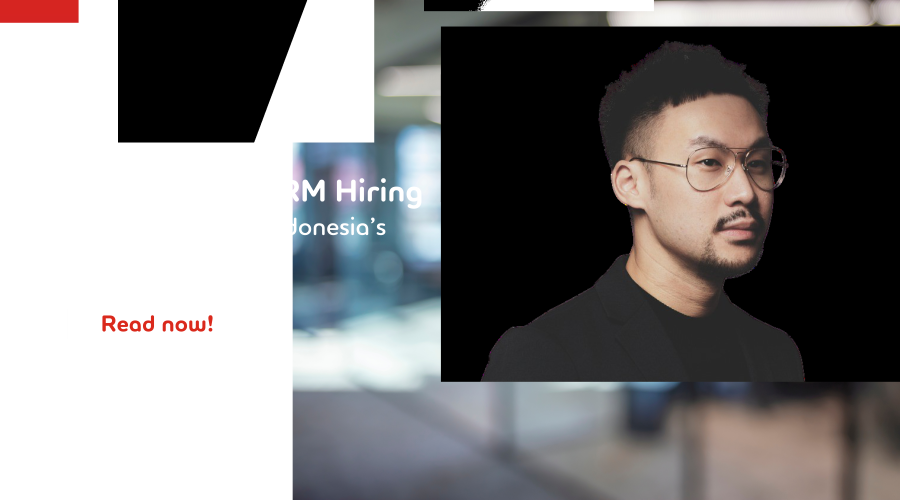
Authored by Justin Tan,
Country Head, Adecco Indonesia
“What went right in Kelly’s hiring, and in others like her?”
Last Friday felt like it was any other day in our Jakarta office. The only difference, and the reason the office was buzzing a little louder than usual — was a visit from our APAC colleague, Kelly. (Yes, coincidentally the same name as our biggest competitor.)
Kelly isn’t our CEO, SVP, or MD. She’s a young manager from a so-called traditional business unit. Her mission? To share how she inherited a conventional team and somehow led them to triple-digit growth last year, in the middle of one of the most turbulent markets we’ve seen. Why do I emphasize the word traditional? Because the word itself carries baggage. Positively, it signals stability, predictability, and dependable demand. Negatively, it suggests resistance to change — and, if you ask Gen Z, even a little boring.
When Kelly walked in, she looked like just another young professional — mid-twenties, slightly nervous, maybe excited. But the moment she started her presentation; she shifted gears completely. Confident. Determined. Poised. The transformation was so striking I caught my colleagues leaning in, eyes lit up. By the time the Q&A rolled around, inspiration was bouncing around the room like sparks.
I sat at the back, quietly observing (yes, a little creepy, but that’s my guilty hobby at work). I’ve known Kelly since day one. In just four years, she went from intern to manager, holding her own alongside leaders twice her years of experience. In the traditional world, how common is such trajectory? Rare, very rare, which made me pause and ask: “what went right in Kelly’s hiring, and in others like her?”
That question brings me back to the very roots of my career. I started in recruitment, helping clients hire for permanent roles. Permanent is a magical word. According to the Dictionary, it means indefinite, long-term. And human instinct kicks in here: if something is permanent, we expect perfection. Many clients have asked me: what’s the secret to making the perfect permanent hire?
The answer, I’ve realized, lies hidden in the word itself: PERM
P is for PotentialA permanent role is an open runway — the value isn’t just in the now but in the next. Too often, companies recruit for short-term fit (today) and overlook long-term growth (tomorrow). The irony? Both the company and the candidate want the same thing: growth.
If a candidate ticks 100% of today’s boxes, chances are they’ll hit the ceiling quickly. Instead, look for someone who has room to stretch — someone who can grow into the role, or even sideways into another. Hiring only for today is like buying myself a shirt that fits exactly — no wiggle room, no growth, and before long, they pinch as I gain weight (it happens at my age).
E is for EssentialHiring managers love wishlists — sometimes dozens of skills crammed into one job description. But the real question is: which of these are truly essential to perform the role, day in and day out?
One of my favorite thinkers, Jordan Peterson, warns against clinging to ideology in his book Beyond Order. The same logic applies here: let go of the nonessentials. Hire for the core skills that matter most and allow the rest to grow. It keeps the role challenging, dynamic, and engaging, for both sides.
R is for ReliabilityLong-term success is built not just on talent, but on reliability. This analogy resonates like whether it’s buying a house or a car, committing to a relationship, or building a career — the test is consistency.
How do you spot reliability in a candidate? Sometimes, it’s not on the resume. Look at their personal commitments. Do they maintain a long-term hobby? Compete regularly in something demanding? Stick with a volunteer project or sport for years? Personal habits echo professional ones. A person who can sustain discipline outside of work often brings that same resilience into the workplace.
M is for MotivationExternal push only goes so far. The best motivation is internal. Simon Sinek, famous for his “Start with Why,” reminds us that people who know their purpose don’t need constant nudging, they’ll chase excellence on their own.
During interviews, ask deeper questions: Why are you here? What drives you to show up every day? A candidate with an authentic “why” has a reason not to fail, and that makes them far more likely to thrive.
As I reflect on Kelly’s journey, I realize she embodied all four letters of PERM from day one. Potential. Essential skills. Reliability. Motivation. This combination is rare, but when you spot it, it changes everything.
For me, the word PERM is no longer just a contract type. It’s a framework. A reminder that the magic of hiring isn’t about finding perfection today, but about building for tomorrow. And if this story is any sign, the future of my Jakarta office looks more than a little magical.